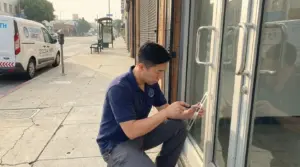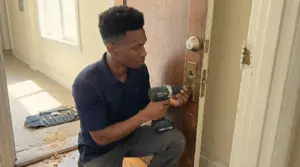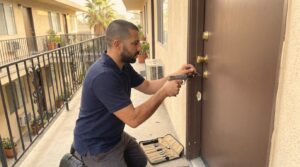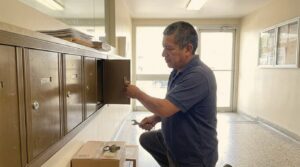
If you are locked out of your apartment in Los Angeles, the fastest legal path back inside is usually short: call the building manager or after-hours line first, and if nobody can let you in, call a professional locksmith who will verify that you live there and open only your unit door. Locksmith Liberty handles apartment lockouts across Los Angeles every day, from Koreatown walk-ups to controlled-access towers in Mid-Wilshire, Hollywood and West LA, and three questions come up on almost every call: who is allowed to open the door, what ID the locksmith needs, and what the lease says about locks. This guide answers all three.
Step one: call the building manager before anyone else
For most Los Angeles apartment lockouts, the building manager is the most direct fix because management holds a key or a master to every unit. Locksmith Liberty’s dispatchers see it constantly: in a Koreatown tower the problem is often a dead fob, not the unit lock, so our first question is whether you are already inside the building. Larger buildings in Koreatown, Mid-Wilshire and Hollywood post an after-hours maintenance number in the lobby, by the mailboxes or on the lease, and California requires a resident manager in buildings with 16 or more units, so there is usually someone to knock for. Call the manager first even if it is late, and keep a screenshot of the call log: if the line fails and you have to pay a locksmith, the record settles any later question about why you did not wait.
Apartment lockout options in Los Angeles compared
| Option | Works when | Watch out for |
|---|---|---|
| Building manager or after-hours maintenance | The building has a master key or spare for your unit and someone is reachable | Nights and weekends in small buildings with no on-site staff |
| Roommate or partner with a key | Someone else on the lease is nearby | You still cannot get through a controlled-access lobby without a fob or a buzz-in |
| Background-checked mobile locksmith | Nobody with a key is available, or the lock itself has failed | Bring ID; the locksmith opens your unit door, not the building’s common doors |
| Property management emergency vendor | Your lease names a required vendor | Some leases bill the lockout back to the tenant; ask before you authorize |
What a Los Angeles locksmith needs to see before opening an apartment door
A legitimate locksmith in Los Angeles will not open an apartment door without proof that the person asking has the right to be inside. Locksmith Liberty asks for one of the following on every apartment lockout, and the technician checks it at the door before any tool touches the lock:
- Government photo ID with the apartment address on it. A California driver license or ID card showing the unit’s address is the simplest proof.
- Photo ID plus a lease, rent receipt or piece of mail for that unit. This is the normal path for anyone who moved recently and has not updated the DMV address, which in Los Angeles is most renters.
- Photo ID plus the building manager’s confirmation. If your paperwork is inside the unit, the technician can confirm your tenancy with the manager or owner by phone before opening the door.
Without one of those, the technician will not open the door; it is the same rule that stops an ex or a stranger from talking their way into your home. LAHD advises tenants to keep digital copies of the lease, rent receipts and utility bills on their phone, and that is the most useful preparation for a lockout.
What Los Angeles leases usually say about locks and lockouts
This section is general information, not legal advice; your lease and the Los Angeles Housing Department (LAHD) are the authorities for your building. That said, standard Los Angeles leases, including the common apartment association forms, are consistent on three points:
- Tenants may not change or add locks without written consent, and must give management a key. Rekeying your own door without telling the manager can put you in breach, even though it feels harmless.
- Lockouts are the tenant’s responsibility, not a landlord repair. Losing your keys is not a habitability problem, so leases typically let the landlord charge a lockout or key fee, or send you to a locksmith at your own expense.
- A broken lock is the landlord’s problem. California Civil Code section 1941.3 requires a working deadbolt on the main entry door of a rental unit, so when a lock fails on its own, the repair belongs to the owner. You can still have a locksmith open it and hand the repair to management.
Most older fourplexes and courtyard buildings in Mid-Wilshire, Koreatown and Hollywood fall under the city’s Rent Stabilization Ordinance (RSO), which generally covers multi-unit buildings occupied before October 1978. The RSO does not change who pays for a lockout, but a landlord cannot use a “lock change” to push a tenant out. LAHD states plainly that a landlord cannot lock out a tenant by changing the locks, even for unpaid rent; only the sheriff with a court order can. If you come home to a changed lock you did not request, that is an illegal lockout, not a locksmith job: LAHD says to call the LAPD non-emergency line at 1-877-ASK-LAPD with your tenancy documents, and the LAHD hotline is 866-557-7368. The full guidance is on the LAHD illegal lockout page.
One more rule: under California Civil Code section 1941.5, a tenant with a restraining order or police report documenting abuse by someone not on the lease can require the landlord to change the locks promptly after a written request, and may change them personally if the landlord misses the statute’s deadline. A locksmith can do that rekey the same day.
Controlled-access buildings: the lobby door is the real obstacle
The hardest apartment lockouts in Los Angeles are not about the unit door; they are about getting into the building at all. Koreatown’s Wilshire corridor, the towers around Park La Brea, the newer mid-rises in Hollywood and the podium buildings in West LA all use fobbed lobby doors and gated garages. A locksmith will not defeat a building’s common-area door or gate. That door belongs to the owner, not to any one tenant, and opening it without authorization would be a security breach for every resident. What the technician can do is meet you at the lobby and open your unit door once you are inside. To get through the lobby door: buzz a neighbor through the call box, reach the building’s after-hours line (many cloud intercom systems can unlock the lobby remotely), or ask the manager to authorize the locksmith by phone or in writing, in which case the technician can work on the common door too. Tell the dispatcher which kind of building you have when you call; Locksmith Liberty asks for the cross streets, the building type and whether you are already inside the lobby so the technician arrives ready.
Smart-lock and keyless buildings
Many newer Los Angeles buildings in Hollywood, Koreatown and West LA have replaced unit keys with keypad or app-based smart locks run by the building (Latch, SmartRent and Schlage-based systems are common). There, a lockout is usually a credentials problem, not a lock problem: the manager or the system’s support line can issue a temporary code or re-enable your phone credential remotely. A locksmith helps when the lock has a mechanical override cylinder and the building cannot find the override key, when the battery is dead and the backup power contact does not respond, or when the deadbolt is physically jammed. If the building owns the smart lock, the technician coordinates with management before replacing any part.
Rekeying after a roommate moves out
A roommate leaving is the most common reason Los Angeles tenants call for an apartment rekey. You usually cannot rekey on your own authority, but most managers say yes quickly when the request is in writing and the office gets a copy of the new key. The process on a typical Koreatown or Mid-Wilshire unit:
- Email the manager: a roommate has moved out and you are requesting a rekey at your expense, with a copy of the new key for the office.
- Once approved, the technician rekeys the existing deadbolt and knob or lever to a new key. The hardware stays and only the pins change, so the door looks identical.
- The technician cuts the keys you ask for, including the office copy.
- If the building uses a master key system, the new cylinder is keyed back onto the master so management keeps the access the lease requires.
Rekey even if the roommate “gave back” the key; copies are easy to make and a rekey cancels all of them. For the wider service, see our residential locksmith page.
Lockouts that need an emergency response
Some apartment lockouts are an emergency: a child or a pet alone inside, a stove left on, or someone locked in rather than out. Those calls go to the front of the line. Locksmith Liberty’s emergency locksmith service runs 24 hours a day across central and west Los Angeles, and the dispatcher tells you exactly what the visit costs before the technician is sent. Renters in Park La Brea and the controlled-access towers along Wilshire can read more on our Miracle Mile locksmith page.
About Locksmith Liberty
Locksmith Liberty is a mobile locksmith company based in Mid-Wilshire, Los Angeles, CA 90036, serving central and west Los Angeles including Mid-Wilshire, Koreatown, Hollywood, Beverly Grove, Miracle Mile, West Hollywood, Culver City and Santa Monica. Technicians respond 24 hours a day, 7 days a week for home, apartment and car lockouts, rekeying, lock installation and repair, car key replacement and programming, and commercial locks and access control. Every job is priced upfront before work begins. Call Locksmith Liberty any time at (213) 314-1971.
Apartment lockout FAQs for Los Angeles renters
Can a locksmith open my apartment door if my ID does not show the address?
Yes, with a second document. In Los Angeles most renters have an outdated DMV address, so Locksmith Liberty accepts a photo ID plus a lease, rent receipt or recent mail for the unit, or a photo ID plus phone confirmation from the building manager or owner. Without any proof of tenancy the technician will not open the door.
Will the locksmith open the building’s lobby door or gate too?
Not without the owner’s or manager’s authorization. Common-area doors in a controlled-access building belong to the building, so a Los Angeles locksmith will meet you at the lobby and open your unit door once you are inside. If management authorizes it by phone or in writing, the technician can work on the common door as well.
Does my landlord have to let me in if I am locked out?
Generally no. A lockout caused by lost keys is the tenant’s responsibility under most Los Angeles leases, and the landlord may charge a lockout fee or direct you to a locksmith. A lock that fails on its own is different: California Civil Code section 1941.3 requires the landlord to maintain a working deadbolt, so that repair is on the owner.
Can I rekey my apartment after a roommate moves out?
Usually yes, with written permission. Most Los Angeles leases bar tenants from changing locks without consent, so email the manager first, offer a copy of the new key for the office, and ask the locksmith to keep the cylinder on the building’s master key if one exists. The rekey keeps the existing hardware and only changes the pins inside.
What if I came home and the landlord changed my lock?
That is an illegal lockout under Los Angeles and California law, not a locksmith job. LAHD says a landlord cannot lock out a tenant even for unpaid rent; only the sheriff with a court order can. Call the LAPD non-emergency line at 1-877-ASK-LAPD with your lease or rent receipts, ask for a report, and contact the LAHD hotline at 866-557-7368.