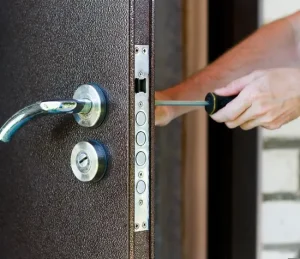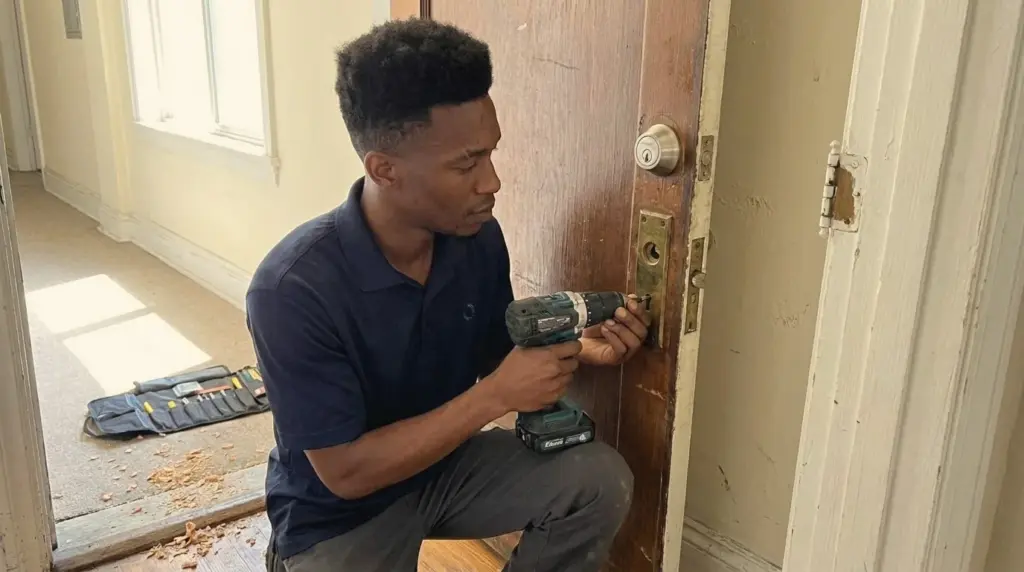
California does not require a Los Angeles landlord to rekey between tenants. It does require, under Civil Code section 1941.3, an operable deadbolt on every main swinging entry door of a rental unit, working locks on every openable window, and code-compliant locks on the common-area doors of a multifamily building. Those are the rules a landlord in Mid-Wilshire, Koreatown or Hollywood actually has to follow at turnover, and the rekey is the practical step that keeps them meaningful. This guide from Locksmith Liberty sets out what the statute says, what it leaves to the landlord’s judgment, and a turnover checklist that covers both.
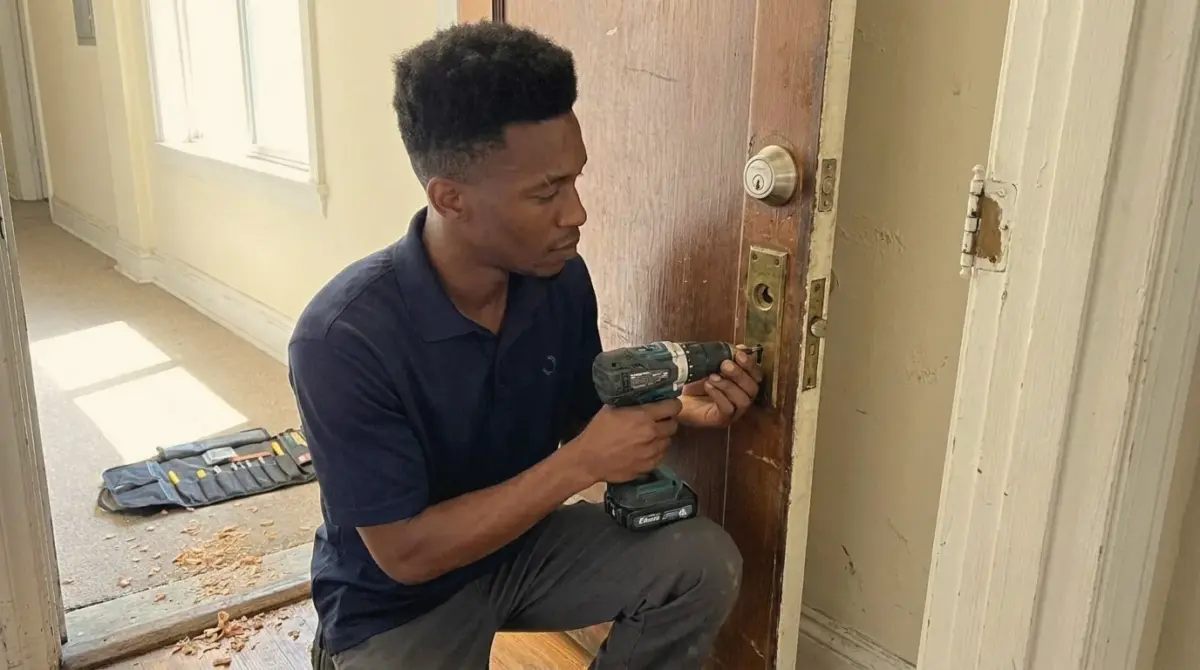
What Civil Code 1941.3 requires on the unit door
Civil Code 1941.3(a)(1) requires the landlord of any building intended for human habitation to “install and maintain an operable dead bolt lock on each main swinging entry door of a dwelling unit.” The statute sets the hardware spec: when locked, the bolt must extend at least 13/16 of an inch beyond the strike edge of the door and protrude into the door jamb, installed to the manufacturer’s specifications and in compliance with fire, life-safety and accessibility codes. Horizontal sliding doors are excluded. The duty has applied since July 1, 1998.
Two grandfather clauses matter in Los Angeles’s older apartment stock. An existing deadbolt with at least a half-inch throw satisfies the section. So does an existing thumb-turn deadlock with a strike plate and a latch bolt held by a guard bolt or plunger, which describes many original mortise locksets on 1920s and 1930s doors in Mid-Wilshire and Koreatown. That older lock only has to be replaced with a 13/16 inch deadbolt “the first time after July 1, 1998, that the lock requires repair or replacement,” and a building formally designated historically significant is exempt from the section altogether under subdivision (f).
Windows, common doors and security bars
Civil Code 1941.3(a)(2) requires operable window security or locking devices on windows designed to be opened, excluding louvered windows, casement windows, and any window more than 12 feet vertically or six feet horizontally from the ground, a roof or any other platform. Subdivision (a)(3) requires the exterior doors into a multifamily building’s common areas to have locking mechanisms that comply with fire and safety codes, which is why a locksmith will not fit an inside key-locked deadbolt on a path of egress. Window bars are regulated separately: Health and Safety Code 13113.9 bars unopenable burglar bars where the Building Standards Code requires an emergency escape opening, and the Los Angeles Department of Building and Safety requires a quick-release that opens from inside without a key, special tools or special knowledge.
The statute at a glance
| Element | What 1941.3 requires | Exceptions and grandfathering |
|---|---|---|
| Main swinging entry door | Operable deadbolt, bolt projects at least 13/16 inch into the jamb | Sliding doors excluded; existing half-inch deadbolts and qualifying thumb-turn deadlocks pass until their first repair or replacement |
| Openable windows | Operable security or locking device | Louvered and casement windows; windows more than 12 ft up or 6 ft out from any platform |
| Common-area exterior doors (multifamily) | Locking mechanism that complies with fire and safety codes | No duty to add a door or gate that did not exist on January 1, 1998 |
| Whole building | Applies to any building intended for human habitation | Buildings designated historically significant are exempt (subdivision f) |
| Timing of liability | Fix an inoperable deadbolt or window lock within a reasonable time after notice | Tenant must notify the landlord when they become aware of the problem (subdivision b) |
What the law does not say: rekeying between tenants
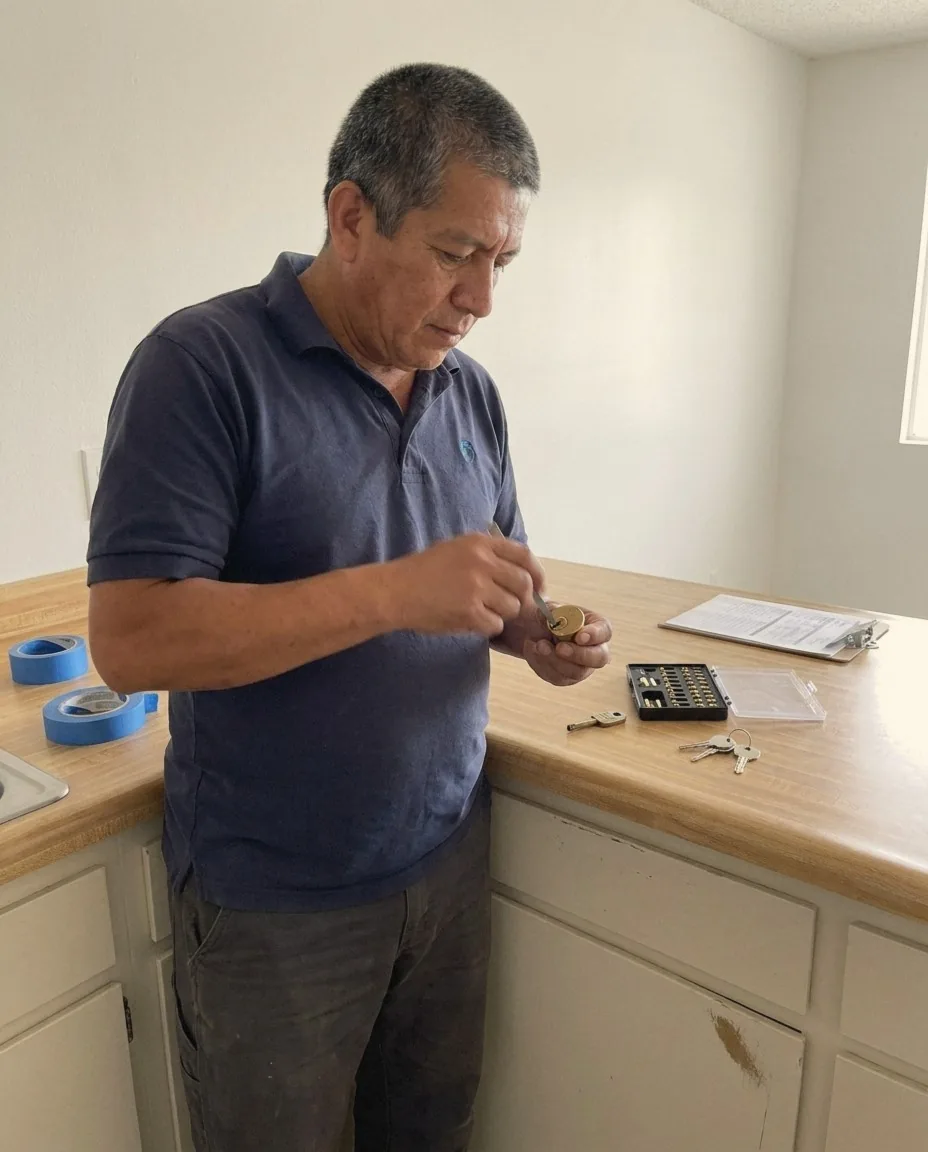
No California statute orders a landlord to rekey a unit when a tenant moves out. Civil Code 1941.3 is about the hardware working, not about who still holds a key. The reason nearly every Los Angeles property manager rekeys anyway sits in subdivision (d): the section does not change “the duty of care owed by a landlord pursuant to existing law,” including Civil Code 1714, the general negligence rule. A landlord who hands a new tenant a unit that a previous tenant, roommate or contractor can still open has a working deadbolt and an unanswered question. Rekeying answers it, and it costs a fraction of a new lock because the cylinder stays and only the pins change.
The exception with a clock is Civil Code 1941.5 and 1941.6. When a tenant who is a victim of abuse or violence, or whose household member is, gives the landlord a written request with the documentation the statute lists, the landlord must change the locks not later than 24 hours later. If the landlord does not, the tenant may change the locks without permission, must give the landlord a key within 24 hours, and the landlord must reimburse the cost within 21 days. Locksmith Liberty handles these calls for tenants and managers across central Los Angeles: the technician verifies identity and the lease at the door, rekeys the unit, and provides the receipt the reimbursement clause depends on.
Who enforces it in Los Angeles
The Los Angeles Housing Department (LAHD) enforces the City housing code and state housing law on roughly 760,000 rental units. Rental properties with two or more units get a Systematic Code Enforcement Program (SCEP) inspection approximately once every four years, any tenant can file a habitability complaint at (866) 557-RENT, and a cited owner gets roughly 30 days to correct. The 1941.3 remedies themselves are civil: repair-and-deduct under Civil Code 1942, breach of contract, an injunction, and an affirmative defense in an eviction for nonpayment.
Turnover checklist for Los Angeles landlords
- Test the entry deadbolt with the door open. Throw it fully and measure the bolt: 13/16 inch or more past the door edge for anything installed or replaced since 1998. A bolt that binds or stops short of the strike is a maintenance item under 1941.3(a)(1).
- Check the strike and the frame. Reinstall loose strikes with long screws into the stud, especially on patched 1920s wood frames.
- Rekey every exterior cylinder to one new key. Entry deadbolt, knob or lever, patio door if keyed, storage and garage pedestrian doors. On a building with a master key system the technician checks the system first so the new unit key still works under the manager’s master; our whole-house rekey guide covers how cylinders are counted.
- Work every openable window and clear smart-lock codes and app users before handover.
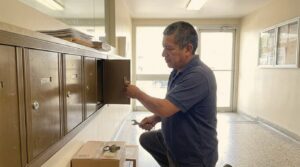
- Mailbox lock. Private apartment mailboxes are the owner’s hardware, not USPS’s; see our mailbox lock replacement guide.
- Log the key code and keys issued, and confirm the lobby, garage pedestrian and courtyard doors latch and lock.
Rekey or replace at turnover
This is how Locksmith Liberty decides on a turnover visit in Los Angeles, after inspecting the door and the existing hardware:
| What the technician finds | Usual recommendation | Why |
|---|---|---|
| Modern pin-tumbler deadbolt, bolt throws fully, strike solid | Rekey | Hardware already meets 1941.3; new pins remove every old key |
| Deadbolt binds, bolt short of 13/16 inch, or cylinder worn | Replace with a Grade 1 or Grade 2 deadbolt, keyed to the new unit key | A repair or replacement event ends any grandfathering and triggers the 13/16 inch spec |
| Original 1920s mortise lock with thumb-turn deadlock, still operating | Rekey the mortise cylinder; add a separate deadbolt above it if the owner wants more security | The grandfather clause allows it until the first repair; a separate deadbolt keeps the period door intact |
| Building on a master key system | Rekey within the system | Preserves the manager’s master; an off-system cylinder locks the manager out |
| Mixed brands with different keyways on one unit | Replace to a single keyway, then key alike | One tenant key for every door; one rekey next turnover instead of several |
| Owner wants code access for turnovers | Keypad deadbolt with a mechanical key override, rekeyed to the building key | Codes change per tenant; the override still has to be a 13/16 inch bolt |
When to call Locksmith Liberty for a turnover
Locksmith Liberty rekeys and installs deadbolts for landlords and property managers across central and west Los Angeles, 24 hours a day, with every turnover quoted upfront by cylinder count and a receipt that lists each cylinder and key for the unit file. Start with our residential locksmith service for a single rental or a whole fourplex, or the commercial locksmith team for mixed-use buildings with storefronts below the units. Tenants locked out rather than moving in should read our apartment lockout guide.
Landlord lock rules FAQ for Los Angeles
Does a landlord in Los Angeles have to provide a deadbolt?
Yes. California Civil Code 1941.3 requires the landlord to install and maintain an operable deadbolt on each main swinging entry door of a rental unit, with the bolt extending at least 13/16 inch into the jamb. Existing half-inch deadbolts and certain older thumb-turn deadlocks are grandfathered until their first repair or replacement.
Does a landlord have to rekey between tenants in California?
No statute requires it. Civil Code 1941.3 covers working hardware, not key control. Landlords rekey because their general duty of care under Civil Code 1714 is unchanged by 1941.3, and a prior tenant’s key is a known risk that a rekey removes at low cost.
When must a landlord change the locks within 24 hours?
Under Civil Code 1941.5 and 1941.6, when a tenant who is a victim of abuse or violence, or whose household member is, makes a written request with the listed documentation, the landlord must change the locks not later than 24 hours after receiving it. If not, the tenant may change the locks, give the landlord a key within 24 hours, and be reimbursed within 21 days.
Do window locks count under the law?
Yes. Civil Code 1941.3(a)(2) requires operable locking devices on windows designed to be opened, except louvered windows, casement windows and windows more than 12 feet vertically or six feet horizontally from the ground, a roof or another platform.
Who do I call if my landlord will not fix the deadbolt?
Notify the landlord in writing first; under 1941.3(b) the landlord is liable only after notice and a reasonable time to fix it. In the City of Los Angeles, the Housing Department’s complaint line is (866) 557-RENT, and the statute also allows repair-and-deduct and other civil remedies.
Sources: California Civil Code 1941.3, Civil Code 1941.5, Los Angeles Housing Department, Living in Rental Housing. General information, not legal advice; check the current statute text and your lease.
About Locksmith Liberty
Locksmith Liberty is a mobile locksmith company based in Mid-Wilshire, Los Angeles, CA 90036, serving central and west Los Angeles including Mid-Wilshire, Koreatown, Hollywood, Beverly Grove, Miracle Mile, West Hollywood, Culver City and Santa Monica. Technicians respond 24 hours a day, 7 days a week for home, apartment and car lockouts, rekeying, lock installation and repair, car key replacement and programming, and commercial locks and access control. Every job is priced upfront before work begins. Call Locksmith Liberty any time at (213) 314-1971.